Nicholas Butko
Postdoctoral Fellow
Institute for Neural Computation
Univ. of California at San Diego
Exploring Exploring since 2004
 |
 |
 |
 |
Jump to: Curriculum Vitae • Publications • Research Interests • Personal
Curriculum Vitae
Updated 24 May, 2011.
Thesis, Publications, Tech Reports, & Talks
NOTE: For PDF versions of papers, please see the MPLab publications page.
- Butko, Theocharous, Philipose, & Movellan, "Automated facial affect analysis for one-on-one tutoring applications." Proceedings of the 9th IEEE Conference on Automatic Face and Gesture Recognition, 2011.
- Wu, Butko, Ruvolo, Whitehill, Bartlett, & Movellan, "Action Unit Recognition Transfer Across Datasets." Proceedings of the 9th IEEE Conference on Automatic Face and Gesture Recognition, Workshop on Facial Expression Recognition and Analysis Challenge, 2011.
- Littlewort, Whitehill, Wu, Butko, Ruvolo, Movellan, & Bartlett, "The motion in emotion - a CERT based approach to the FERA emotion challenge." Proceedings of the 9th IEEE Conference on Automatic Face and Gesture Recognition, Workshop on Facial Expression Recognition and Analysis Challenge, 2011.
- Butko, "Active Perception," Ph.D. Thesis, UC San Diego dept. of Cognitive Science, 2010.
Awarded 2011 Jean Fort Dissertation prize by UC San Diego Office of Graduate Studies.
- Butko & Movellan, "Infomax Control of Eye Movements." IEEE Transactions on Autonomous Mental Development, 2(2):91-107. 2010.
- Butko & Movellan "Detecting Contingencies: An infomax approach." Neural Networks 23:973-984. 2010.
- Butko & Movellan "Learning to Look." Proceedings of the 2010 IEEE International Conference on Development and Learning, 70-75. 2010.
- Theocharous, Butko, & Philipose, "Designing a Mathematical Manipulatives Tutoring System Using POMDPs," Proceedings of the POMDP Practitioners' Workshop: Solving Real-world POMDP Problems, International Conference on Automated Planning and Scheduling, Toronto, May 2010.
- Beckwith, Theocharous, Philipose, Butko, Schmied, & Mathew, "IRL: Virtual Reality and Pysical Manipulatives," Proceedings of the Workshop on Next Generation of HCI and Education, ACM Conference on Human Factors in Computing Systems, Atlanta GA, April 2010.
- Wu, Butko, Ruvulo, Bartlett, & Movellan, "Learning to Make Facial Expressions,", Proceedings of the 2009 IEEE International Conference on Developmental Learning (ICDL), 2009.
- Butko & Movellan, "Optimal Scanning for Faster Object Detection", Proc. IEEE Conference on Computer Vision and Pattern Recognition (CVPR), 2009
- Theocharous, Beckwith, Butko, & Philipose, "Tractable POMDP Planning Algorithms for Optimal Teaching in SPAIS," IJCAI Workshop on Plan, Activity, and Intent Recognition, (2009).
- Butko & Movellan, 2008, "I-POMDP: An Infomax Model of Eye Movement, Proceedings of the 2008 IEEE International Conference on Development and Learning (ICDL), August 9-12, 2008
- Butko, Zhang, Cottrel, & Movellan, 2008, "Visual Saliency Model for Robot Cameras," Proceedings of the 2008 International Conference on Robotics and Automation (ICRA), pp. 2398-2403, Pasadena, CA, USA, May 19-23, 2008.
- Butko & Movellan, 2007. "Learning to Learn," Sixth International Conference on Development and Learning (ICDL2007).
- Wiratanaya, Lyons, Butko, & Abe, 2007. "iMime: An Interactive Character Animation System for use in Dementia Care." Intelligent User Interfaces (IUI2007), Hawaii.
- Butko 2007, "Generative & Discriminative Naive Bayes." Technical Report, MPLAB.UCSD-1, April, 2007.
- Butko & Triesch, 2007. "Exploring the Role of Intrinsic Plasticity for the Learning of Sensory Representations," Neurocomputing, 70(7-9):1130-1138.
- Bajramovic, Mattern, Butko & Denzler, 2006. "A Comparison of Nearest Neighbor Search Algorithms for Generic Object Recognition." Advanced Concepts for Intelligent Vision Systems (Acivs 2006), Antwerp, Belgium.
- Butko, Fasel & Movellan, 2006. "Learning about Humans During the First 6 Minutes of Life," Fifth International Conference on Development and Learning (ICDL5), Bloomington, Indiana, USA. [Talk Only]
- Butko & Triesch, 2006. "Exploring the Role of Intrinsic Plasticity for the Learning of Sensory Representations," European Symposeum on Artificial Neural Networks (ESANN'06), Bruges, Belgium.
Research Interests
My ultimate interest is the grand quest of Cognitive Engineering, Viz. How can we build machines that are as truly adaptable and intelligent as organisms?
The question of how we can define, understand, and construct intelligence has been addressed by many great minds. In the beginning, it was thought that intelligence was ultimately rooted in reason and thought. My own experience and intuition suggest that this notion should be turned around. Reason and thought do not form a core from which perception and action spring and through which they mingle; perception and action underlie and give rise to everything cognitive.
It is my belief that we can only advance AI by commiting to approaches that are ultimately rooted in pereception, action, and iteraction with an uncertain and changing world. To this end, we must be students of probability, uncertainty, dynamics, information, and prediction. To address the problems of interacting with a changing world, it is important to commit ourselves to efficient methods that sacrifice "correctness" for getting the job done in time, before the world has moved on without us. We must create theories that are robust in the face of what the world can throw at us, and we must implement those theories in the real world (or domains of similar complexity) to make sure they hold.
A model of intelligence must prove itself by doing more intelligent things in the real world than researchers have been able to achieve before.
Personal
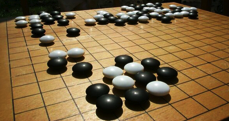
Go:
- Play online: KGS
- KGS handle: thenjb
- Current KGS Rank: 11k
- Daily Problem: TsumeGo of the Day
- Reference: Sensei's Library
- Wikipedia entry: Go (board game)
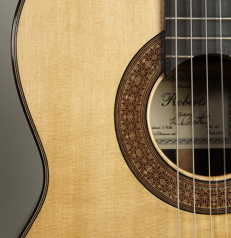
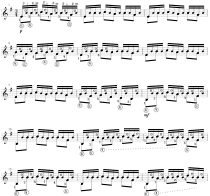
Classical Guitar:
- Now Playing: Guardame Las Vacas / Minuet in G Minor