Institute for Neural Computation
Marian Stewart Bartlett, Ph.D.
|
|
Full Research Professor University of California, San Diego, 0523 9500 Gilman Drive La Jolla, CA 92093-0523 Phone: (858) 822-5241 Fax: (858) 534-2014 Email: marni –at- salk.edu |
I
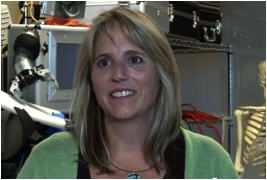
am Research Professor at the Institute for Neural Computation, UCSD. I
co-direct the Machine Perception Lab, where I lead the Computational Face
Group. I study learning in vision, with application to face recognition and
expression analysis. One area of focus explores models of unsupervised learning
and their application to face processing. For example, principles of
information maximization which have been associated with neural coding in early
vision, also relate to findings in human face perception, such as other-race
effects, face adaptation aftereffects, and perceptual effects relating to
typicality. These ideas are reviewed in a recent paper. Another major focus of my
research is the development of automatic facial expression recognition systems.
In collaboration with other members of the Machine Perception Lab, we have
developed an end-to-end system for automatic recognition of a set of basic
expressions that works in real-time. We have also made substantial progress
toward fully automating the facial action coding system, a comprehensive facial
expression description system developed by Paul Ekman and Wallace Friesen. For
a summary of our recent work in this area, see the following review
chapter. I received my bachelor's degree in Mathematics and Computer
Science from Middlebury College in 1988, and my Ph.D. in Cognitive Science and
Psychology from UCSD in 1998. My thesis work was conducted with Terry Sejnowski
at the Salk Institute and is described in my book, Face Image
Analysis by Unsupervised Learning, Kluwer 2001.
Machine
Perception Lab
Research
interests
· Image analysis
through unsupervised learning.
· Face
recognition.
· Facial
expression analysis.
· Independent
component analysis for pattern recognition.
Activities
· Director of
Scientific Programs, UCSD Science of Learning Center on the Temporal
Dynamics of Learning.
· Program
Co-Chair, IEEE International Conference on Automatic Face and Gesture
Recognition, Santa Barbara, March 2011
· Associate
Editor for Neurocomputing.
· Guest Editor.
Image and Vision Computing, Special Issue on the Best of Face and gesture, 2011
· Guest Editor. IJPRAI Special Issue on Face Image
Processing and Analysis
· Guest Editor. Neurocomputing Special Issue on Deveopment and Learning
· Program Co-Chair, International Conference on Development and Learning, 2004
· Chair, Learning in Vision KES 2002
· matlab code for face representations using ICA
· Participating faculty for the IGERT program for Vision and Learning in Humans and Machines at UCSD.
·
Teaching: CSE 291: Topics on
Vision in Humans and Machines
Obtain a
copy of the Computer Expression Recognition Toolbox (CERT)
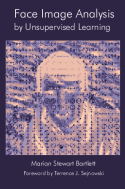 Face
Image Analysis
Face
Image Analysis
by
Unsupervised Learning
Marian
Stewart Bartlett
Kluwer
International Series on Engineering and Computer Science, V. 612. Boston:
Kluwer
Academic Publishers, 2001. Ordering
Information (888)-640-7378. Also available on Amazon.com.
Foreword by Terrence J. Sejnowski
Table of Contents
Book Jacket
Face
Image Analysis by Unsupervised Learning explores adaptive approaches to face
image analysis. It draws upon principles of unsupervised learning and
information theory to adapt processing to the immediate task environment. In
contrast to more traditional approaches to image analysis in which relevant
structure is determined in advance and extracted using hand-engineered
techniques, [this book] explores methods that have roots in biological vision
and/or learn about the image structure directly from the image ensemble.
Particular attention is paid to unsupervised learning techniques for encoding
the statistical dependencies in the image ensemble.
The first part of this volume reviews unsupervised learning, information
theory, independent component analysis, and their relation to biological
vision. Next, a face image representation using independent component analysis
(ICA) is developed, which is an unsupervised learning technique based on
optimal information transfer between neurons. The ICA representation is
compared to a number of other face representations including eigenfaces and
Gabor wavelets on tasks of identity recognition and expression analysis.
Finally, methods for learning features that are robust to changes in viewpoint
and lighting are presented. These studies provide evidence that encoding input
dependencies through unsupervised learning is an effective strategy for face
recognition.
Face Image Analysis by Unsupervised Learning is suitable as a secondary text
for a graduate level course, and as a reference for researchers and practioners
in industry.
"Marian Bartlett's comparison of ICA with other algorithms on the
recognition of facial expressions is perhaps the most thorough analysis we have
of the strengths and limits of ICA as a preprocessing stage for pattern
recognition."
- T.J. Sejnowski, The Salk Institute
May 7, 2001: